
Feature
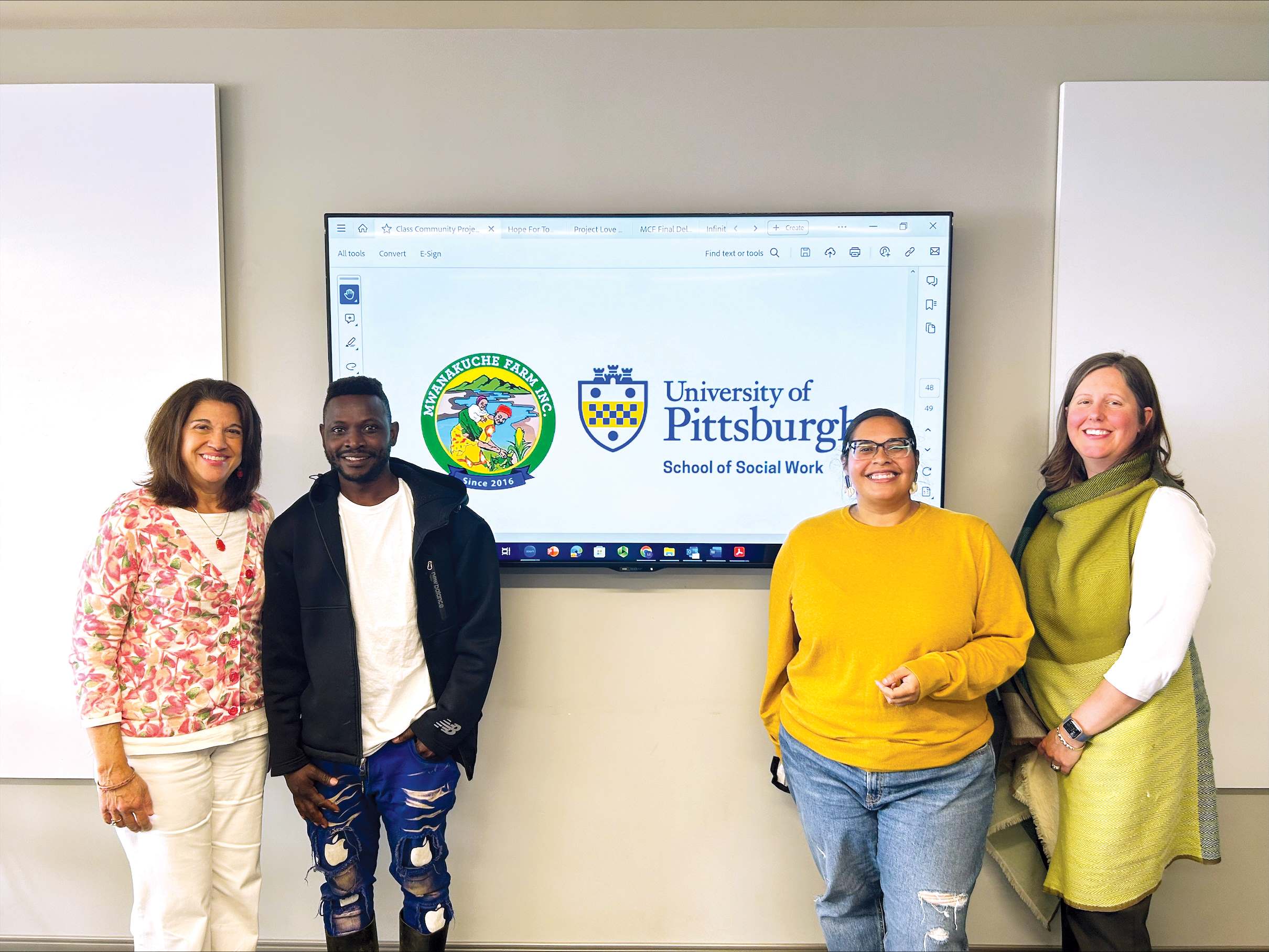 A cornerstone of the Community, Organization, and Social Action (COSA) concentration in the University of Pittsburgh School of Social Work Master of Social Work program is providing students with the tools and experiences they need to bridge academic learning with real-world community engagement. In addition to their practicum placements, students in the Community Organizing and Planning class (a mandatory core course) and the Community Planning and Development class (a core elective) participate in projects that demonstrate the program’s commitment to addressing pressing social issues through collaborative, community-facing work.
Previously, these projects were directed by faculty, with entire classes working on a single professor-developed initiative. In 2017, Associate Professor and COSA Chair Mary Ohmer (MSW ’86, PhD ’04) revamped the model, allowing organizations to propose their own projects. These organizations might have had prior interactions with students (through practicum placements, for example) but had not previously engaged in collaborative projects like this. Students select which projects to pursue based on their interests, fostering student autonomy and allowing the school to engage multiple organizations each term. Through their involvement with community organizations, students gain invaluable skills in project management, fundraising, and strategic thinking, all while addressing pressing community needs. The hands-on experience allows students to connect their academic learning with real-world applications, reinforcing their commitment to social work and community engagement. For the organizations, this partnership alleviates workload and enhances their capacity to serve. The fresh perspectives and innovative ideas brought by students lead to tangible improvements, such as increased funding and enhanced outreach strategies. As a result, both students and organizations grow stronger together, creating a cycle of support that empowers communities and cultivates the next generation of leaders in social action. This dynamic collaboration enriches the students’ educational experience and strengthens the fabric of the communities they aim to uplift.
H.O.P.E. for Tomorrow and Mwanakuche Community Farm are two local organizations that jumped on the opportunity to collaborate with students.
H.O.P.E for Tomorrow is a Pittsburgh-based non-profit founded by Keysha Gomez to address the need for youth programming in the area. Starting in her living room in 2010 with just six kids, Gomez aimed to provide safe, supportive spaces for youths to learn and grow. Today, the organization provides year-round programming, including life skills and academic enrichment classes, for students from grade three through their second year of postsecondary education. The organization also has a robust parent program that offers workshops on topics such as financial literacy and wellness.
Gomez’s project proposal goal was to raise funds for Kulture Dance Academy’s end-of-year recital, which is a branch of H.O.P.E. for Tomorrow. Offering dance classes like ballet, jazz, modern, hip-hop, and tap, Kulture Dance Academy is an organization that provides students with expert training. Because of this level of training, it can be challenging for families to afford classes and participate in the end-of-year recital. In the spring of 2024, four students chose this project, including Seongbo Son (MSW ’24). The project, which exposed students to stakeholder meetings, fundraising and outreach, volunteer recruitment, and event promotion, resulted in more than $15,000 raised and led to improvements in fundraising strategies for future years.
Son chose H.O.P.E. for Tomorrow and the Kulture Dance Academy because of Gomez’s commitment to improving the lives of vulnerable populations, particularly underprivileged youths. Son emphasizes that this project was pivotal for his growth as a student and a professional, stating that “it reinforced my commitment to working in community-based social work and provided me with practical insights into effective project management and community engagement.” Now a PhD student at the University of Chicago Crown Family School of Social Work, Policy, and Practice, Son hopes to further investigate and develop community-based models and solutions and calls the knowledge and skills he gained from the COSA program “instrumental in achieving these goals and making a meaningful impact in the field of social work.”
This year, H.O.P.E. for Tomorrow plans to work with a new cohort of students to focus on organizational capacity, building practices and policies that aid in the longevity and strength of the organization.
Supporting grassroots organizations not only eases staff members’ workloads but also directly impacts the communities being served. Giving organization leaders and students the autonomy to shape the project opens the door to matching skill with need. Laura Farra Myers (MSW ’24) and Abby Bonilla (MSW ’24) appreciated the opportunity to learn more about the city around them through their involvement with Mwanakuche Farm, located in Pittsburgh’s Perry South neighborhood and Mercer County, Pennsylvania. Both saw an opportunity to support a smaller organization and expand on their current strengths and future goals.
Mwanakuche Farm is a volunteer-run, Somali Bantu-led and -serving organization that provides more than fresh produce to the community. Executive Director Abdulkadir Chirambo says that “healing is the biggest part of our life.” His goal is to provide his community with the tools and resources to thrive emotionally, mentally, and physically.
“They do a great job of finding funding for the work they do,” Myers says. “It wasn’t immediately clear just how good they were at this.” Because of this already-strong foundation, Myers and Bonilla organized grant data and enhanced stories that could be told to funders, furthering Chirambo’s mission to expand the opportunities to aid his community in the process of healing.
Because the two farms are in separate counties, Bonilla and Myers had to learn about their different funding streams. They reached out to foundations in Mercer County to build relationships and make funding partners aware of the farm while strengthening the work already started in Allegheny County. As someone not from the Pittsburgh area, Abby mentioned having to adapt and learn to be “comfortable with the uncomfortable to get the resources you need, an important notion of being a social worker.”
The COSA program’s emphasis on strategic thinking and community impact resonated with Myers and her vision for helping communities, families, and organizations. She had experience with grant writing, so this project was a good fit for her and allowed her to further expand this skill set. For Bonilla, the project pushed her to refine her client-led, strength-based approach and develop her networking and cold-calling skills. A joint MSW/MBA student, Bonilla chose the COSA concentration because of a desire to integrate her nonprofit background with a future in business, carving a pathway to strategic resource management. The COSA program’s emphasis on real-world application has been instrumental in preparing her for a transition into the corporate realm after graduation.
Small but mighty, the COSA program at Pitt Social Work is one deeply committed to developing agents of change. Outside their class and practicum responsibilities, students show a commitment to these organizations, which is a testament to the impact they will continue to make.